

If you search for house cleaners near you in Central Florida, you'll get two kinds of results mixed together: cleaning companies with a team and an office number, and independent cleaners who run the whole thing themselves. Both can do excellent work. Both can also go badly. The difference is mostly in who carries the risk when something goes wrong, and how much of the managing you want to do.
We're a cleaning company, so we'll say that up front. We also know plenty of independent cleaners in Polk and Osceola who do great work, and for some households they're the better fit. Here's a fair side-by-side so you can decide for yourself.
The Short Version
An independent cleaner usually costs less per hour, gives you the same person every time, and can be very flexible about small requests. You take on more of the vetting, more of the risk if someone gets hurt or something breaks, and the job of finding coverage when they're sick or on vacation.
A cleaning company usually costs more, because the price includes insurance, payroll, supplies, scheduling and backup staff. In exchange you get someone to call when there's a problem, a replacement when a cleaner is out, and less paperwork on your side. Some companies rotate staff a lot, which is a real downside if you want the same faces each visit.
Small family-owned companies sit somewhere in the middle, and the questions near the end of this post will help you sort out who you're really dealing with.
Insurance and Liability
This is the biggest practical difference, and it's the one people skip. Picture a cleaner slipping on a freshly mopped tile floor, or a bottle of cleaner landing on your quartz counter. Someone pays for that. With an insured company, its general liability policy is meant to cover damage to your property, and its own coverage handles its workers. With an uninsured independent, the bill may land on you or your homeowner's policy.
Workers' compensation is part of this. Florida's Division of Workers' Compensation requires non-construction employers with four or more employees (including part-time) to carry coverage. That means a very small cleaning business may not be required to have it, and a sole proprietor working alone usually isn't. Plenty of independents do carry general liability insurance, though, and it's a fair thing to ask.
Whoever you hire, ask for a certificate of insurance, not just a yes. It's also worth a quick call to your homeowner's insurance agent to ask how your policy treats an injury to someone working in your home. Krystal View is insured in the State of Florida, and any company you're considering should be able to say the same and show it.
Consistency and Backup When Someone Is Sick
With an independent cleaner, you get the same person every time. They learn where you like the throw pillows, which shower door sticks and that the dog hides under the guest bed. That familiarity is worth a lot.
The weak spot is coverage. When your cleaner has the flu, a sick kid, car trouble or a week off, your visit is usually skipped. For a regular home, that's an inconvenience. For a vacation rental with a same-day turnover in ChampionsGate, a skipped clean means a guest walks into a dirty house, which is why most hosts want a vacation rental cleaning provider with more than one person on call.
A company can usually send someone else. The trade-off is that larger companies sometimes send whoever is free, so you end up explaining your house to a new person every few weeks. Ask directly how they assign staff. For our recurring cleaning clients, we send the same team each visit, and that's a reasonable thing to expect from any company you're paying for regular service.
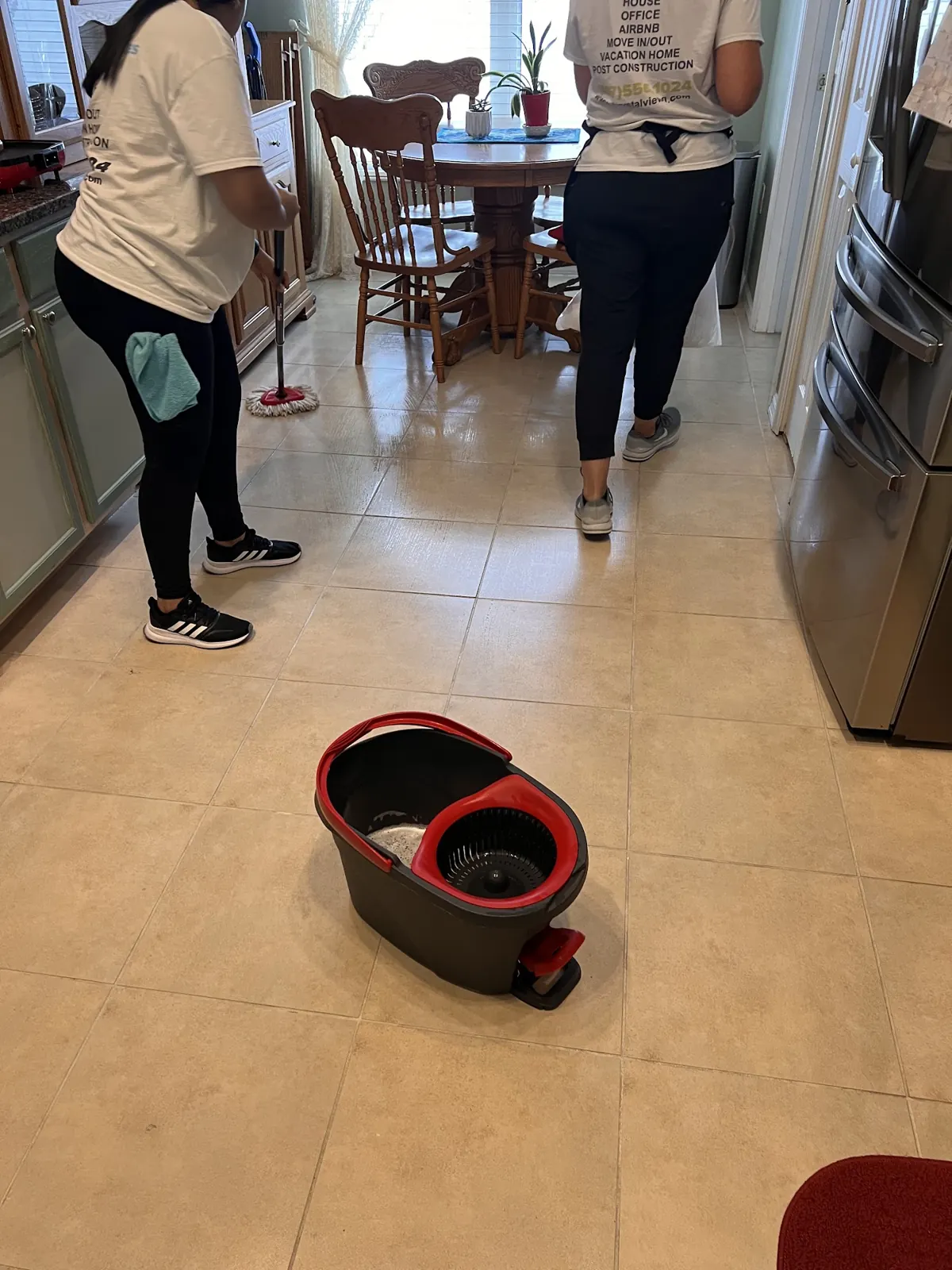
Vetting and Trust
Someone you hire will have access to your home, often while you're at work. With a company, ask what screening they do before hiring and what it actually includes. Don't settle for a vague answer. With an independent, the vetting is on you: check ID, ask for two or three references from current clients (and call them), and read reviews on Google or Nextdoor rather than only the ones a cleaner screenshots for you.
Reviews help with both options. A long run of recent reviews that mention specific details (the same cleaner by name, how a problem was handled) tells you more than a star rating. You can read ours on our reviews page, and do the same homework on anyone else you're considering.
Supplies and Equipment
Companies almost always bring their own products, vacuums, mops and microfiber. Independents vary. Some bring everything, some ask you to provide products, and some expect to use your vacuum. If you're supplying, that cost belongs in your comparison.
Ask what products they use, especially if you have kids, pets, natural stone or allergies. We use Bon Ami and other non-toxic products. Whatever someone uses, they should know which cleaners are safe on marble, which are safe on shower glass with hard-water spots, and never mix bleach with ammonia or acidic cleaners.
Price
Independents are usually cheaper per hour because they have less overhead. Fixr's January 2025 cost guide lists individual cleaners at about $25 to $40 per hour for basic cleaning and companies at about $40 to $50 per hour. Those are national figures, and local rates vary.
The gap isn't pure profit. A company's price typically covers liability insurance, payroll taxes, workers' comp where required, supplies and equipment, scheduling and someone answering the phone, plus the slack to cover sick days. When comparing quotes, compare the full picture: who supplies products, how long they'll be on site, what's included, and what happens if a visit is missed. Our house cleaning cost guide explains what drives quotes in more detail.
Flexibility and Communication
An independent cleaner is often the most flexible option. You text one person, they can swap a day or spend extra time on the oven, and decisions happen on the spot. The risk is the same thing that makes it easy: everything depends on one person's phone and calendar.
Companies tend to have clearer policies about scheduling, cancellations and redos. That can feel less personal, but it also means there's a process when something isn't right. We ask clients to tell us within a day if something was missed, and we come back to redo it free. Ask any company what its version of that is, and ask an independent the same question. A good one will have an answer.
Taxes: When You Might Become a Household Employer
This is the part most comparison articles get wrong or skip. If a cleaner works for you directly and you control what they do and how they do it, the IRS may treat them as your household employee. IRS Publication 926 for 2026 says that if you pay cash wages of $3,000 or more in 2026 to any one household employee, you generally need to withhold and pay Social Security and Medicare taxes. Federal unemployment (FUTA) tax applies if you pay $1,000 or more in total cash wages to household employees in any calendar quarter. You'd report these on Schedule H with your tax return.
Whether a cleaner counts as your employee depends on control, not on what you call them. The same IRS publication says a worker provided by an agency that controls what work is done and how isn't your employee. It also says a self-employed worker who controls how the work is done isn't your employee. Self-employed cleaners usually bring their own tools and offer services to the general public through their own business.
In practice, most independent cleaners who serve several clients, set their own methods and bring their own supplies are self-employed. A cleaner who works only for you, on your schedule, doing things your way, using your supplies, looks more like an employee. If you're unsure, IRS Topic 756 and Publication 926 are the official guides, and a tax professional can look at your situation. With a company, this question doesn't come up for you, since the cleaners are on its payroll.
Questions to Ask Either Option
Ask these on the phone or before the first visit. How someone answers tells you as much as the answers themselves.
- Can you send a certificate of insurance? What does it cover?
- Who exactly will be cleaning my home, and will it be the same person or team each time?
- What happens if you're sick or can't make it? Will someone else come?
- Do you bring supplies and equipment? What products do you use?
- What's included in a standard visit, and what costs extra?
- How do you handle something that wasn't cleaned well, or something that gets broken?
- How do you handle keys, door codes and alarm codes?
- What's your cancellation policy, for me and for you?
- Can I talk to a couple of current clients?
Which One Fits Your Home
An independent cleaner tends to fit best if you work from home or are around during visits, your schedule can flex when they're out, you've found someone with solid references and insurance, and you want the lowest hourly cost.
A company tends to fit best if you won't be home during cleanings, you can't afford a skipped visit (vacation rentals, busy families, snowbirds who need the house opened before they land), you'd rather not deal with insurance or tax questions, or you want a clear process when something needs fixing.
Either way, it helps to prepare your home before the first appointment so the cleaner can spend the time cleaning instead of picking up. If you'd like to see how a family-owned company handles your home, ask us for a free estimate or call +1 877-754-5614.

