

Most people who ask for eco-friendly cleaning want two things: no harsh fumes in the house, and nothing on the floor that worries them when the baby crawls across it or the dog licks the tile. That's a reasonable ask, and most weekly cleaning in a Florida home can be done with mild products. Some jobs can't, at least not quickly, and knowing which is which saves a lot of scrubbing.
This guide covers what labels like "green" and "non-toxic" do and don't promise, which jobs gentle products handle well, where they need more time on the surface, how to clean around pets and kids, how we use Bon Ami, and the one rule that matters more than any label: never mix bleach with ammonia or acids.
What "green" and "non-toxic" mean on a label
Less than you'd hope. Words like "natural", "non-toxic" and "eco-friendly" aren't a certification. The EPA tells shoppers to be careful with vague or generic claims such as "environmentally friendly", "eco safe" or "green", which it calls greenwashing.
It also helps to remember that almost anything is harmful in the wrong dose or the wrong place. Baking soda stings in an eye. A product can be easy on your skin and still be hard on aquatic life once it goes down the drain. Read "non-toxic" as "lower hazard when used as directed", not "harmless".
The label that does mean something specific is EPA Safer Choice. According to the EPA, every ingredient in a certified product, regardless of percentage, must meet its safety criteria for human health and the environment. Certified products must perform comparably to conventional ones, meet pH limits meant to reduce skin and eye irritation, and stay within VOC limits that protect indoor air, and EPA audits them every year. For disinfectants and sanitizers, the matching logo is Design for the Environment (DfE). Both can be searched on EPA's website.
Plenty of good mild products don't carry either label. For those, EPA's own list of greener features makes a practical filter: low VOC content, fragrance-free, a pH between 4 and 9.5, ready biodegradability and low aquatic toxicity.
Jobs mild products handle well
Most of the dirt in a Florida home on a normal week is dust, sand, skin oils, light cooking grease, toothpaste and soap residue. None of that needs anything strong. EPA's guidance on greener cleaning notes that many general cleaning tasks, like walls and floors, don't usually need a disinfectant at all.
- Counters, tables and cabinet fronts: warm water with a drop of dish soap, or a pH-neutral all-purpose cleaner, on a microfiber cloth
- Tile and vinyl plank floors: a pH-neutral floor cleaner diluted as the label says; too much soap leaves a sticky film that attracts dirt (more in our guide to cleaning luxury vinyl plank floors)
- Glass and mirrors: plain water and a good microfiber glass cloth handles most fingerprints
- Stainless appliances: damp microfiber, wiped with the grain, then dried
- Sinks, tubs and stovetops: a gentle powder cleanser like Bon Ami on a damp sponge, then a rinse
- Baseboards, blinds and fan blades: a damp cloth and nothing else
Microfiber does half the work
A lot of what people expect from a strong spray actually comes from the cloth. Microfiber lifts dust and grime mechanically, so you need less product, and it rinses clean. Use separate cloths for bathrooms and kitchens (color-coding makes it easy) so you're not carrying toilet grime to the counter, and wash them hot without fabric softener, which coats the fibers.
Where mild products need more time, not more strength
The trade-off with gentle products is speed. Strong chemistry dissolves buildup fast. Mild chemistry needs dwell time, meaning time sitting wet on the surface, plus some elbow grease. In a Florida house these are the jobs where that shows:
- Soap scum on tubs and shower walls: apply the cleaner, let it sit for several minutes as the label directs, then scrub with a non-scratch pad. In a warm bathroom, mist it again if it starts to dry
- Hard-water spots on glass and fixtures: Central Florida's hard water leaves mineral rings that soap won't lift. A mild acid such as diluted white vinegar works if you give it contact time. Keep vinegar off natural stone like marble and travertine. Our hard water stains guide covers the stubborn cases
- Baked-on oven grease: a baking soda paste left for several hours or overnight, then worked off with a plastic scraper (step by step in our kitchen deep cleaning checklist)
- Greasy range hood filters: soak in very hot water with dish soap, then brush
- Mildew in grout and caulk: mild products clean surface mildew, but stains that have soaked into caulk often need a stronger product or new caulk. See how to remove mildew in a Florida shower
When you actually need to disinfect
Cleaning removes dirt and most germs with it. Disinfecting kills what's left, and that's where "mild" has limits. Vinegar and baking soda aren't EPA-registered disinfectants. When you do need to kill germs, such as after raw chicken on the counter or a stomach bug in the house, clean the surface first, then use an EPA-registered disinfectant (one with the DfE logo if you want the lower-hazard option) and follow the label's contact time.
EPA defines contact time as how long the product must remain on the surface to be effective, and says the surface should stay visibly wet for that entire time. Spraying and wiping straight off doesn't disinfect. Save disinfectants for bathroom fixtures, door handles and other high-touch spots, which is also where EPA suggests focusing them.
Cleaning around pets and kids
Babies and pets live at floor level and put their mouths on everything, so residue matters most on floors, low surfaces and anything they eat from. For hair, dander and accident cleanup, see our pet-friendly house cleaning tips.
- Use less product than you think, and follow with a plain-water damp mop if the label says to rinse; residue is what paws and hands pick up
- Ventilate while you clean (a window or the bath fan), and keep kids and pets out of the room until floors are dry
- Store every product up high and capped, gentle or not
- Wash pet bowls, high chair trays and teething toys with dish soap and hot water, then rinse well
- Go easy on fragrance; plug-ins and heavily scented sprays add to what's in the air, and fragrance-free is on EPA's list of greener features
- Ask your vet before using essential-oil cleaners or diffusers around pets, especially cats
- Keep the Poison Control number saved in your phone
How we use Bon Ami, and where we don't
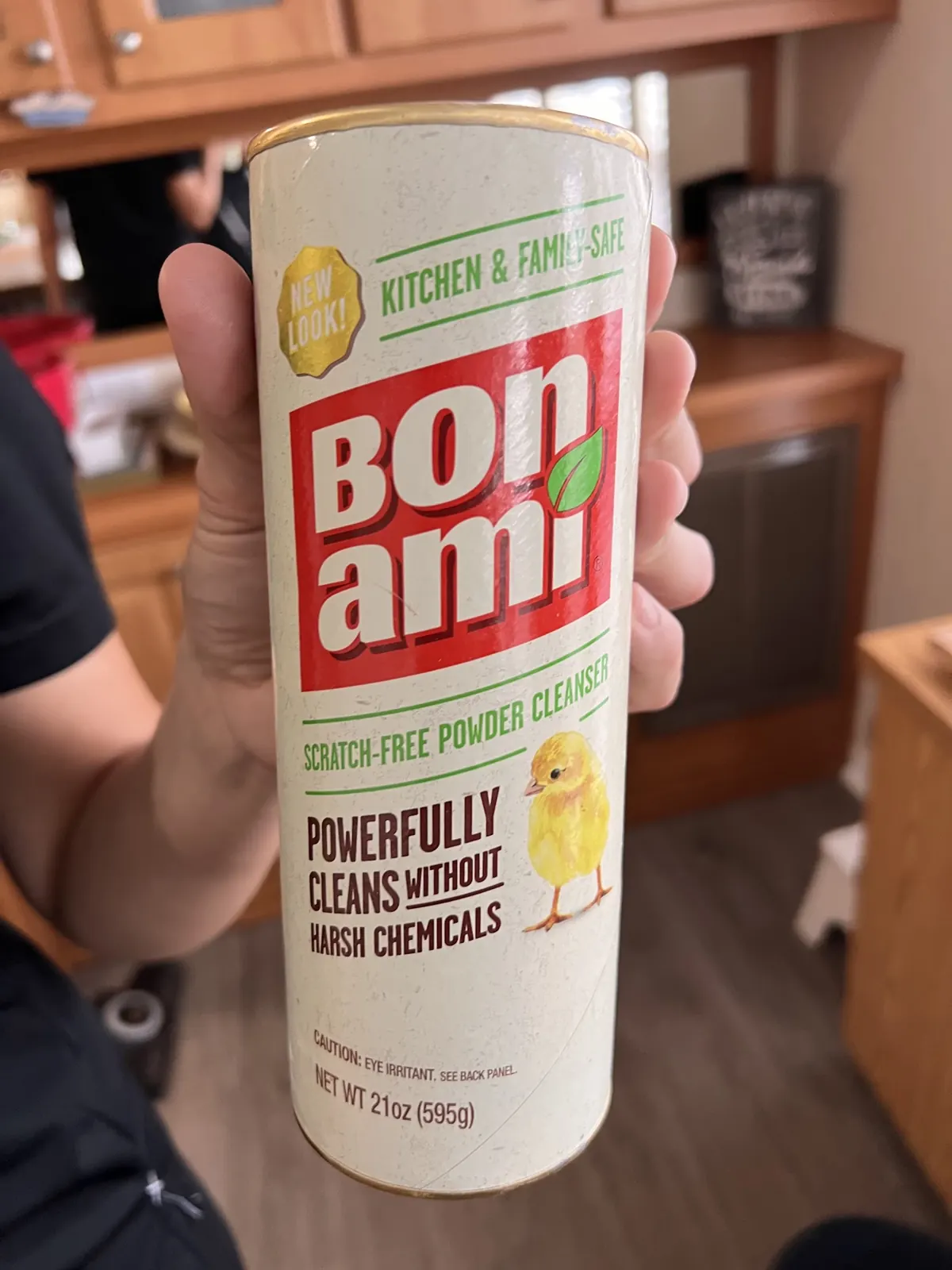
Bon Ami Powder Cleanser is one of the products we use most at Krystal View, and it's worth being specific, because "we use green products" tells you nothing. Bon Ami's product page lists five ingredients: limestone (calcium carbonate), feldspar, soda ash, baking soda and a surfactant. The company describes it as biodegradable and free of harsh chemicals, calls it gentle enough for most hard surfaces, and says neither of its current products is tested on animals.
We use it on tubs, sinks, stovetops and other kitchen and bath surfaces where a little scrubbing power helps, and we follow Bon Ami's own cautions: test first on highly polished, painted or decorative surfaces, keep it off non-stick cookware, and don't use it on windows, mirrors or other glass. Glass gets water and microfiber or a glass cleaner instead.
It isn't the only thing in the caddy. For heavy hard-water scale, carbon baked onto an oven, or a bathroom that needs disinfecting, we use a product made for that job, as its label directs, with the room ventilated. A stronger product used in one spot beats scrubbing a finish dull with something too weak.
Never mix bleach with ammonia or acids
This rule beats any label. Bleach mixed with ammonia releases chloramine gases. Bleach mixed with an acid, such as vinegar, many toilet bowl cleaners and rust or lime removers, releases chlorine gas, the reaction a CDC MMWR report on chlorine gas from mixed household cleaners describes. In a small Florida bathroom with the door shut, either one can hurt your lungs.
- Use bleach only with water, as its label directs. AARP's bleach-safety guidance names ammonia, vinegar, hydrogen peroxide and alcohol as things not to combine with it
- Don't follow one product with another on the same surface without rinsing well in between
- Don't pour different cleaners into the same toilet or drain
- Open a window or run the fan, and leave the room if your eyes or throat start to burn
- Spot-test anything new in a hidden area first
What to ask a cleaning company about green products
If a low-tox clean matters to you, ask what's actually in the caddy instead of asking whether a company is "green". Gentle products don't get a pass on the mixing rule either, so it's fair to ask how a crew handles that too.
- Which products do you use on floors, counters and bathrooms, and can I see the labels?
- What do you use when something needs disinfecting, and do you follow the contact time?
- Do you keep separate cloths for bathrooms and kitchens?
- How do you handle hard water and soap scum without harsh chemicals?
- What do you do differently around pets and small kids?
Getting a low-tox clean at home
On a standard house cleaning or a recurring visit, our crew works with Bon Ami and other non-toxic products that are safe around kids and pets, and steps up to something stronger only where a job calls for it. Tell us about your pets, your floors and anything you'd like us to avoid, and ask for a free estimate.

